
Through research they seek to gather new information and contribute to seabird conservation
Cabila Manríquez and Génesis Ríos have been part of the Oikonos team for two years, supporting the archipelago’s endangered species conservation efforts. During January and February, the young islanders left their vacations and joined the organization in different sites in Robinson Crusoe. Both devoted part of their free time to learning and helping on research that later became part of their studies on the continent.
But why do Cabila and Génesis sacrifice their vacations for the conservation of island biodiversity? They both deeply love their land and ever since they were little, they felt the desire to continue their studies on the continent in return of everything they had learned.
Cabila finished her studies to be a veterinarian at the University of Concepción, where she spent the last five years. Today she is working on her thesis, which is focused on the Pink-footed Shearwater (Ardenna creatopus), a seabird that she learned about when she was monitoring nests during the reproductive season. Her thesis compares the success of reproduction in the different nesting colonies, both in Juan Fernández and in Isla Mocha. “I feel that this is a very important and unique opportunity because I will be contributing to the knowledge of a local endangered species that lacks research. It is a probability that data shows that the Shearwaters that live in Santa Clara are the most successful with their chicks, since they do not have invasive animals that attack them,” says Cabila. In addition, she adds “I hope that this effort will help more people in the community value our birds and all of our nature.”
On the other hand, Génesis carried out her thesis with one of the most unknown and least studied seabirds, the Masatierra Petrel, also known as De Filippi´s Petrel (Pterodroma defilippiana), which only nests on the islands of Santa Clara and San Ambrosio and in the Juanango and Verdugo islets. Génesis wants to continue her work in conservation through her studies as a Technician in Environmental Control at Universidad Santa María of Viña del Mar. “It has been a new and different experience to the volunteering that I did last year. This one is something more serious, you have goals to meet. But by far the coolest thing is that we are two young women islanders that are conducting scientific research within the community,” said Génesis, who also added that “this research will analyze data that other Oikonos team members have recorded since 2010 with great effort, it is not easy to go to Santa Clara in winter to collect data”.
The work of these two young women helps conserve two endemic and endangered species that nest in Chile. The Pink-footed Shearwater and the Masatierra Petrel are under the category of Endangered and Vulnerable, respectively, according to the Regulation of Classification of Species (RCE) of the Ministry of the Environment.
The data generated, first by Peter Hodum, and later by various islanders who have been part of Oikonos, will help these empowered young women to generate more and better scientific information. Without a doubt, Cabila and Génesis are opening a door that we hope will never close, giving the opportunity to new generations of islanders to study and protect local threatened species and ecosystems through science and conservation actions.
Related Blogs
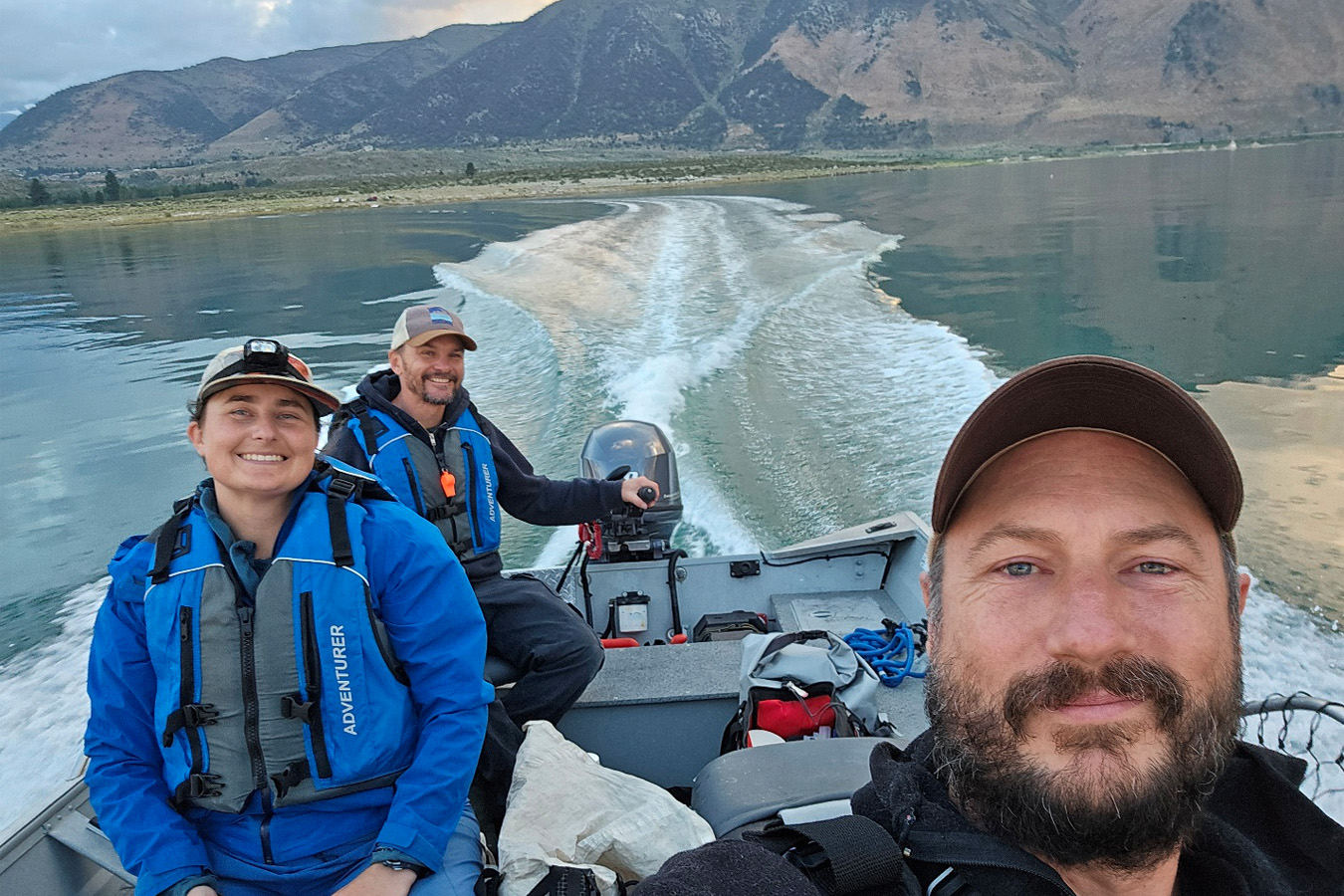
Phalarope Tagging at Mono Lake: An Update from Science Director Ryan Carle
In 2025, Oikonos launched the project “Promoting the Conservation of the Humboldt Penguin in Chile and Peru”, an initiative aimed at strengthening scientific research, environmental education, and conservation efforts for one of the most iconic species of the Humboldt Current.

The collaboration of those who work at sea every day can make a big difference in conservation: An interview with Simón Zepeda
In 2025, Oikonos launched the project “Promoting the Conservation of the Humboldt Penguin in Chile and Peru”, an initiative aimed at strengthening scientific research, environmental education, and conservation efforts for one of the most iconic species of the Humboldt Current.

Individual Actions Matter: The Humboldt Penguin Is Now a Natural Monument
Individual actions have a greater impact on the collective than we often realize. Thanks to more than 9,000 people who took part in the public consultation, the Humboldt Penguin has now been declared a Natural Monument.