

Conservation
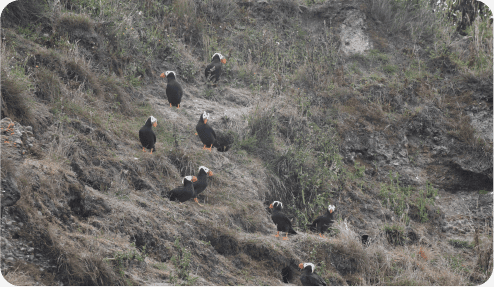
In the recent past, Tufted Puffins nested on many islands on the west coast of the U.S. Though populations are still strong in parts of Alaska, within the last century their populations have declined by >90% in California, Oregon and Washington, and they are in danger of disappearing entirely from this important part of their range. The factors causing this decline are complex and interacting, and include historic oil spills, historic fisheries bycatch, increases in predator populations, and ecosystem changes related to warming ocean waters and shifting forage fish prey bases. Our research is unravelling how these factors affect puffins, to identify effective conservation measures to help the species thrive. We have leveraged our research to help get Tufted Puffins listed as Endangered by Washington State, Sensitive by Oregon, and as a Species of Special Concern in California. Our collaborative research and conservation program focuses on tracking population trends over time, assessing drivers of regional declines, conducting outreach and education programs for the public and policy-makers, and laying the foundation for potential future active restoration efforts on puffin breeding colonies.

About the species
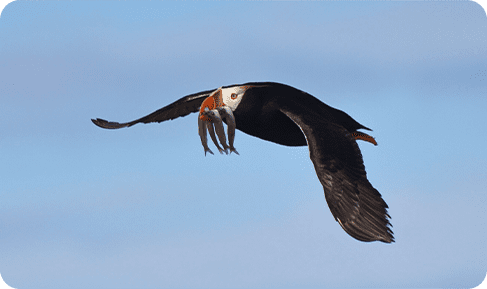
Tufted Puffins are a widespread seabird that breed along the Pacific Rim from California through Alaska in North America and in Japan and Russia in Asia. The only part of its range that has a stable breeding population is the western Aleutian Islands. They breed on mammalian predator-free islands, typically in burrows that they excavate. During the breeding season, they forage for small fish over the continental shelf and shelf break, carrying whole fish back to their chicks in their bills. Tufted Puffin migration is poorly understood, although they are thought to spend the winter months on the open ocean in the north Pacific.

Other Species

Humboldt Penguin
Humboldt Penguin Endemic species of the Humboldt Current, an extraordinarily productive marine ecosystem.Conservation In the 19th century, hundreds...

Wedge-tailed Shearwater
Wedge-tailed Shearwater This oceanic seabird often feeds with tuna schools and serves as an important sign of ocean health in the warm waters of the...

Wilson’s Phalarope
Wilson’s Phalarope A small and charming migratory shorebird that specializes on saline lake habitats, the Wilson’s phalarope is threatened with...

Cassin’s Auklet
Cassin’s Auklet Experts at diving for small krill and larval fish, these seabirds are vulnerable to changes in ocean temperature and...

Masafuera Rayadito
Masafuera Rayadito It is a poorly known and critically endangered landbird unique to only one island in the worldNatural history Endemic to the...

Juan Fernández Firecrown
Juan Fernández Firecrown Endemic to Robinson Crusoe Island and on the verge of extinction.Natural history Only inhabits the native forest of...

Black-footed Albatross
Black-footed Albatross A charismatic ambassador for ocean stewardship, this species travels vast distances to forage and encounters many threats...