
By Matías Portflitt Toro
March 23rd, 2026
In 2025, Oikonos launched the project “Promoting the Conservation of the Humboldt Penguin in Chile and Peru”, an initiative aimed at strengthening scientific research, environmental education, and conservation efforts for one of the most iconic species of the Humboldt Current.

The Humboldt Penguin (Spheniscus humboldti) is a species currently facing multiple threats, and its populations have declined significantly over recent decades. Photo by Andrea Benvenuti.
Among the factors affecting this species is bycatch, particularly in gillnets and purse seine nets. Gaining a clearer understanding of how this occurs and how frequently it happens is essential to properly assess this under-studied threat and, if necessary, to design effective mitigation and conservation measures.
To advance this effort in the Coquimbo region, Simón Zepeda Monardez—a small-scale fisher from Guanaqueros—joined the Oikonos team in mid-2025.

Simón is currently an active collaborator in collecting data on Humboldt Penguin bycatch (the unintentional capture of non-target species in fisheries) and contributes to the project’s education and outreach efforts.
We spoke with Simón about his life at sea, his relationship with the Humboldt Penguin, and the importance of fishers playing an active role in marine biodiversity research and conservation.
A life connected to the sea
Those who make their living from the ocean develop a deep connection to their environment. Over the years, fishers become firsthand witnesses to the changes taking place in marine ecosystems and the species that inhabit them.
We asked Simón about his journey as a fisher and how he has seen the ocean change over time.
How long have you been a fisher? How has the ocean and its species changed over that time?
Simón:
My life has been connected to the sea for more than 20 years. From a young age, I was involved in spearfishing and supporting dockside fishing activities. I later received formal training at the Carmen Rodríguez Maritime High School in Tongoy, Chile, where I learned about marine aquaculture, including the cultivation of scallops, mussels, and abalone. During those years, I also had my first experiences working aboard fishing vessels.
When I was starting out, there were periods of great abundance, with high levels of extraction of marine resources in my local area—both from small-scale and industrial fishing, as well as diving. Today, however, the availability of commercially valuable species has decreased considerably.
Historically, the Coquimbo and Atacama regions hosted some of the most abundant Humboldt Penguin colonies across the species’ entire range. In places like Guanaqueros, their presence is part of both the ecosystem and local identity, with records of a small colony nesting on rocky outcrops known as La Puntilla. However, as with many species, their populations have faced ongoing threats over time.
Before collaborating on this project, what was your relationship with the Humboldt Penguin?
Simón:
The Humboldt Penguin has always been a characteristic species of the bay where I live, in Guanaqueros. It has long been, and continues to be, an iconic and charismatic bird that attracts tourism.
Based on your experience, what threats has the Humboldt Penguin faced, and what threats does it face today?
Simón:
As long as I can remember, Humboldt Penguins have been present in the Guanaqueros area. Over time, I personally observed an important colony nesting season after season in the bay. But about ten years ago, feral dogs attacked the colony, killing almost all the individuals. After that, their numbers declined significantly.
When fishers engage in science
Fishers hold invaluable knowledge about the ocean. Their daily experience navigating, fishing, and observing marine ecosystems helps complement scientific research and generate a more complete understanding of what is happening in the ocean. This is often referred to as traditional ecological knowledge.
In Simón’s case, his connection to research began long before he joined this project.
How and why did you decide to actively participate with Oikonos in this project?
Simón:
During my professional training, I had the opportunity to work for nearly a decade as a Scientific Observer with the Fisheries Development Institute (IFOP). I started by collecting data at docks and landing sites, and later worked as an onboard observer. This allowed me to learn much more about the marine fauna that lives in and moves along our Chilean coasts.
Through this experience, I came to understand that conservation is a critically important branch of research. From that point on, I began to see things differently every time I went out to fish or dove beneath the surface.
When the opportunity arose to actively collaborate with Oikonos, I didn’t hesitate for a moment. It allowed me to continue contributing to the protection of the Humboldt Penguin while strengthening this perspective of care and conservation for ecosystems and the species that depend on them.

Within the project, Simón plays a key role in collecting data on the interaction between Humboldt Penguins and small-scale fisheries.
Tell us about your role—what specific data are you collecting on bycatch?
Simón:
One of my main responsibilities in the project is to record data on the incidental capture of Humboldt Penguins on small-scale fishing vessels in the Coquimbo region, across different types of fishing gear. Bycatch is considered a major factor behind the species’ population decline, alongside other pressures such as climate change and the reduced availability of their primary prey in the area (small pelagic fish).
Educating to conserve
The conservation of marine biodiversity depends not only on scientific research. It also requires raising awareness and strengthening the connection between coastal communities and the biodiversity that surrounds them.
In this context, fishers play a fundamental role as stewards of the ocean within their own communities.
What message would you share with other fishers, or with children and young people in the community, to help protect this species?
Simón:
I believe this message needs to be shared from early childhood, so it can reach entire families and build awareness about how harmful it would be to lose such an important species from our marine ecosystem. Among my fellow fishers, there is now a growing recognition of the penguin’s importance, especially given its noticeable decline. Many express a commitment to protecting the few individuals that are still seen in the bay today.
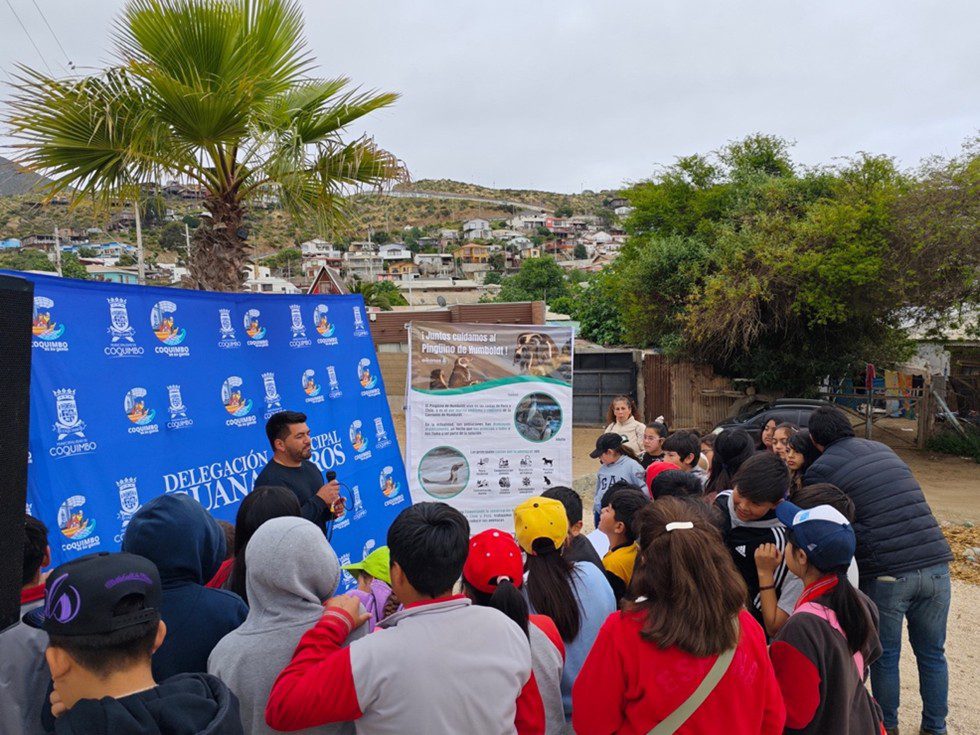
Simón raising environmental awareness while sharing his knowledge during a beach cleanup event in Guanaqueros.
Do you think fishers’ collaboration is key to conserving the Humboldt Penguin?
Simón:
Absolutely! The awareness and commitment of fishers to protect the Humboldt Penguin are present every day. We see how much their populations have declined, which motivates us to help, rescue, or release any individuals in need.
For Simón, a key factor in advancing initiatives like this is listening to and involving the communities and those who live and work at sea daily.
What is needed for other fishers to join these initiatives?
Simón:
From my years interviewing fishers across different ports in the country, I’ve learned that they need to be included and consulted in every decision that involves them.
Science and communities: a collaborative effort
This blog, where we explored Simón’s work, highlights a fundamental aspect of biodiversity conservation: collaboration between science and local communities.
The traditional ecological knowledge that fishers possess comes from years of hands-on experience and direct observation. Integrating this knowledge into research not only helps us better understand the challenges faced by species like the Humboldt Penguin, but also strengthens the connection between people and biodiversity protection.
Experiences like this demonstrate that ocean conservation does not rely solely on scientists or institutions—it also depends on the commitment of those who live and work at sea every day.

Simón Zepeda and Verónica López, Oikonos’ Project Manager, alongside other organizations at the Humboldt Archipelago Cultural and Heritage Festival. These festivals provide an opportunity to connect with nature and recognize the role each individual can play through their daily actions.

Written by Matías Portflitt Toro
Edited by Gabriela Lamanna
March 23rd, 2026