
Phalaropes are tiny shorebirds that specialize on saline lakes during their incredible migration from North to South America. Mono Lake is one of their most important migratory stops–tens of thousands of them stop for a month or so each summer to feast on the lake’s invertebrates before continuing south. Phalaropes are rightly famous for these impressive characteristics, and among researchers, they are also famous for something else—being notoriously hard to catch! Small and fast, they fly with aerial prowess, turning on a dime to evade predators, or, on the odd occasion, our researchers’ clunky nets. Over the past ten years, biologists throughout the western hemisphere have tried various techniques to capture these zippy shorebirds, mostly without success. In the summer of 2025, Oikonos biologists set out on Mono Lake just before sunset for several nights, hoping to find and capture Wilson’s and Red-necked Phalaropes (Phalaropus tricolor) to attach nanotags with transmitters that would help us begin to answer the myriad questions we have about these amazing little travelers. We know that Wilson’s Phalaropes rely on inland saline lakes and Red-necked Phalaropes (Phalaropus lobatus) winter on the Pacific Ocean, but that knowledge is too vague when you want to help these species survive a rapidly-changing climate and the severe threats to many saline lakes from water diversion. How long do individuals stay at Mono Lake? Where exactly do they go after they leave? How long do their journeys take? What habitats do they rely on during their flight to their wintering grounds? The questions that tagging can help us answer are endless.

Wilson’s Phalarope in winter plumage (Photo by Forrest English)
At Oikonos, we have been trying to catch phalaropes for three years, but before 2025, we had successfully tagged only one Wilson’s Phalarope at Mono Lake. The capture method finally came together this summer—two bright spotlights, a long-handled net, and a fearless crew zooming around Mono Lake on five dark, moonless nights resulted in the capture of 11 phalaropes! Four were juvenile Wilson’s Phalaropes, and seven were Red-necked Phalaropes. This marks the first time Red-necked Phalaropes have been fitted with transmitters in the United States.

The phalarope boat ready to launch on Mono Lake (Photo by Ryan Carle)
Once we had the birds in the hand, we banded them with a USGS numbered metal band and carefully glued a CTT Lifetag radio nanotag the size and weight of a standard paperclip (1 gram) to their upper back feathers. These particular tags can be detected by Motus towers, stationary telemetry arrays that are being set up all over the world, particularly along migratory pathways. The Mono Lake Committee, who partner with Oikonos to support science at Mono Lake, installed three new Motus arrays around Mono Lake this year, just in time for our tagging campaign. The glue is expected to last weeks to months before falling off, and this method is considered the safest tag attachment method for the birds.

Tagged Wilson’s phalarope at Mono Lake (Photo by Forrest English)
The results so far have been fascinating. One Wilson’s phalarope left Mono Lake on July 30, two days after being tagged, and traveled 1,028 km from Mono Lake to the Middle San Pedro River Preserve east of Tucson, Arizona. This bird was then detected an hour later 89 km south near the Arizona/Mexico border, which means it was flying about 30 miles per hour. It hasn’t been detected since, which means it hasn’t passed within detection range of a Motus tower (10-15 km), or that the tag fell off.

Track of Wilson’s Phalarope deployment 58171
Another Wilson’s phalarope left Mono Lake on July 30, two days after being tagged, and was detected at the Middle San Pedro River Preserve, Arizona, 46 hours later—the same location where the first phalarope was detected.
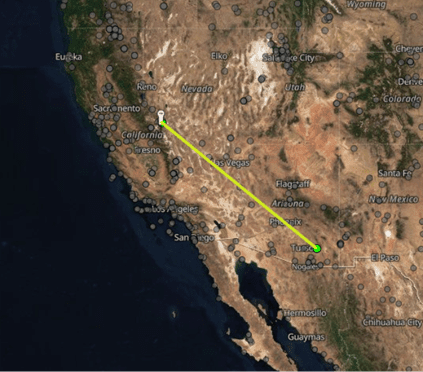
Track of Wilson’s phalarope deployment 58093
The third Wilson’s phalarope left Mono Lake on August 1, four days after being tagged, and traveled 989 km in 19 hours to east-central Arizona. This bird then crossed into New Mexico and was detected at a series of stations as it headed south, including Bill Evans Lake near Silver City, New Mexico, and the Red Rock and Chihuahuan Desert IBA stations farther south in New Mexico. This bird was last detected on August 4 near Durango City, Mexico, 1,035 km from the previous detection near Lordsburg, New Mexico, and over 2,200 km (1,400 miles) from Mono Lake.
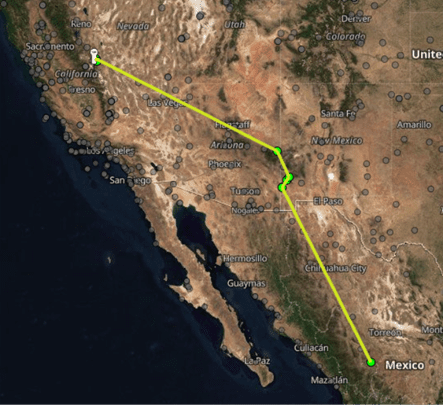
Track of Wilson’s phalarope deployment 48613
The fourth Wilson’s Phalarope was detected at Mono Lake from July 29 to August 4 and was not detected afterward. In addition to being detected by the stationary Motus towers, we also located this bird at Mono Lake using a handheld detector on August 1. During that detection, the bird was associated with a flock of approximately 4,200 Wilson’s Phalaropes at the South Tufa area.
There were over 18,000 Wilson’s Phalaropes at Mono Lake this summer, and we know that at least three of the four we tagged traveled very similar paths inland and then south! This info has already shed new light on phalarope migration, especially that of juveniles, whose migratory movements are poorly understood. We never before knew about these inland migratory routes through the southwest U.S. and northern Mexico, and the new information highlights the importance of areas that had not previously been on our radar for conservation of the species, such as the San Pedro River in Arizona.
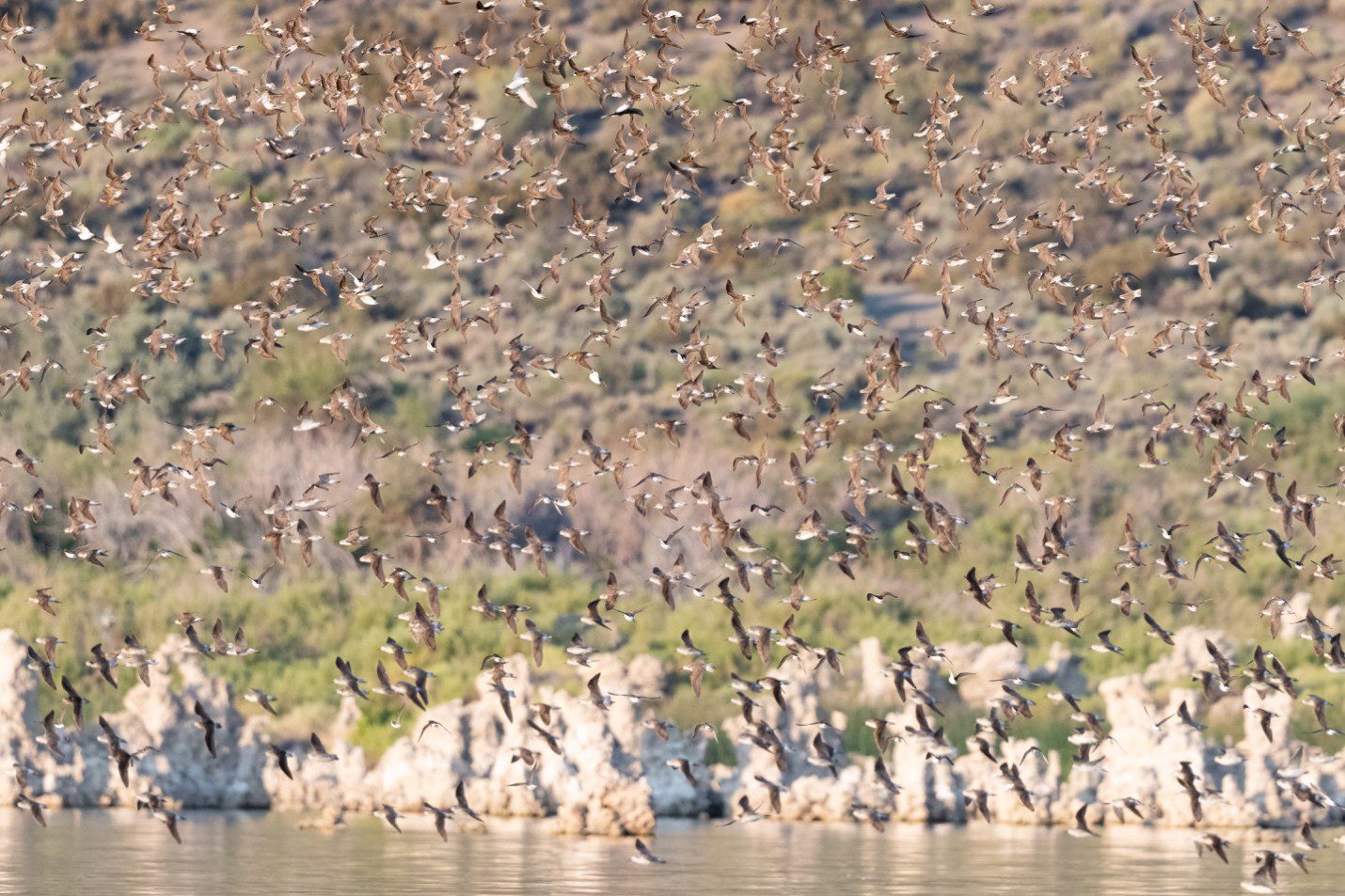
Wilson’s Phalarope flock at Mono Lake (Photo by Forrest English)
Much attention has been focused on Wilson’s Phalaropes in recent years, but Red-necked Phalaropes also rely heavily on threatened saline lake habitats, and their movements are even more mysterious to us than those of Wilson’s phalaropes. For example, we know that Wilson’s phalaropes stop for 4-6 weeks at salt lakes to fatten up for migration, but we still aren’t sure how long individual Red-necked Phalaropes stay at places like Mono Lake—is it just a couple days, or is it weeks or months? And where do Red-necked Phalaropes go after they leave Mono Lake—straight to the ocean, or to other interior wetlands? Before this summer, we just didn’t know these answers.
The seven Red-necked Phalaropes we captured and tagged this summer have shown interesting migratory pathways, shedding new light on our understanding of the species. One flew south along the Eastern Sierra and out to the ocean by the Channel Islands of Southern California before heading southeast to the Colorado River delta at the Gulf of California. Another flew over the Sierra to the Central Valley, down to the Channal Islands, over to Arizona, and then back west to the Salton Sea. A third bird was also detected at the Channel Islands after leaving Mono Lake and then journeyed south to the Guerrero Negro lagoon on the Pacific coast of Baja California, Mexico. A fourth bird was detected at the Channel Islands after leaving Mono Lake and not subsequently detected. Two additional birds were detected at Mono Lake for several days after they were tagged, and have not been detected since early August. A final individual was not detected after tagging, likely indicating an issue with the tag’s functionality. Interestingly, for all the birds that we detected leaving Mono Lake, the first movement was to go to the ocean off southern California within twenty-four hours, even though some birds cut back inland afterward. These results highlight a fascinating connection between Mono Lake and the Pacific Ocean, and underscore how much more there is to learn.
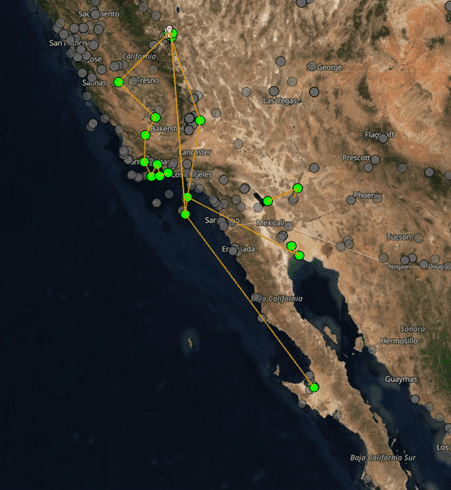
Movements of six red-necked phalaropes after leaving Mono Lake.
These exciting tagging results are just the beginning. A glimpse into the flightpaths of these dainty shorebirds has already shown us so much, and we are eager to find out more. Phalarope research will resume at Mono Lake in summer 2026, and we plan to tag more phalaropes in July or August of next year. Our Mono Lake results are contributing to a larger effort to tag phalaropes throughout the hemisphere, and in the last three years phalaropes have also been tagged by our collaborators in Canada, at Great Salt Lake, and in Argentina. We will continue to collaborate with scientists throughout the western hemisphere who are working to understand the species’ patterns to protect them from habitat loss and destruction due to water diversion, lithium mining, and climate change.
You can explore the full, real-time tagging results at motus.org, for both our Phalarope Movement Across the Americas project page, and results from all projects throughout the hemisphere by species for Wilson’s phalarope and red-necked phalarope.
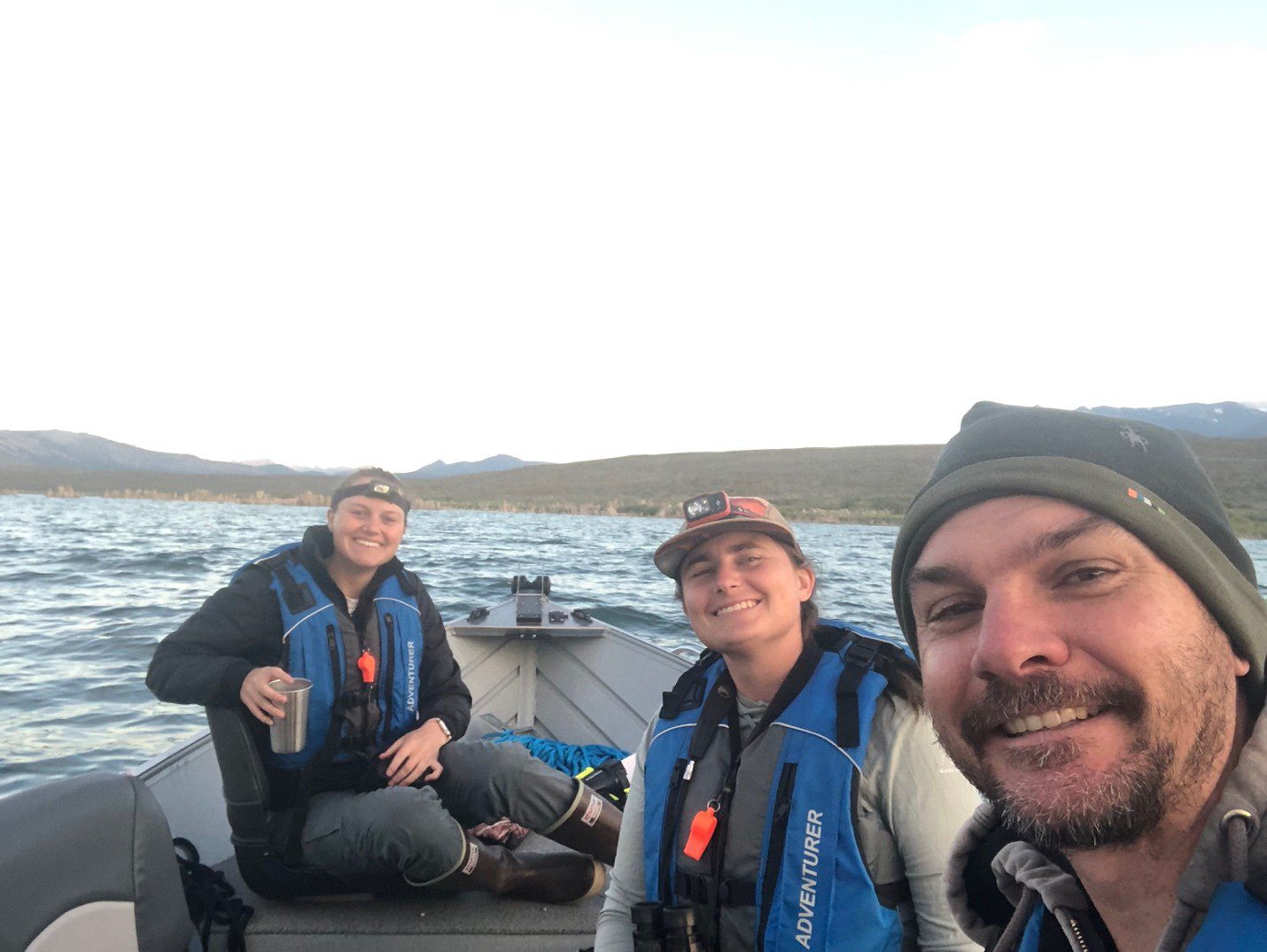
The phalarope tagging team waiting for dark (Katie, Nora, Ryan, Forrest not shown) (Photo by Ryan Carle)
Written by: Nora Livingston and Ryan Carle
November 10th, 2025