
Hawaiʻi: Freeman Seabird Preserve
In the heart of Honolulu, we provide ‘ua‘u kani safe nesting habitat through community-powered restoration and education.
An urban refuge for a Hawaiian seabird
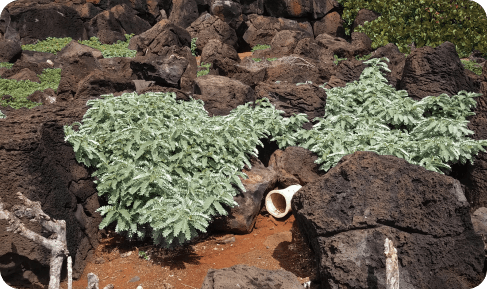
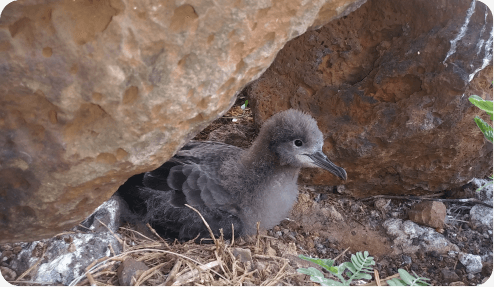
The main Hawaiian Islands are home to over one million people and many species are in peril of habitat loss. ʻUaʻu kani, also known as Wedge-tailed Shearwaters, once nested widely across the main Hawaiian Islands, but most breeding sites have disappeared due to development, introduced predators, and proliferation of weeds.
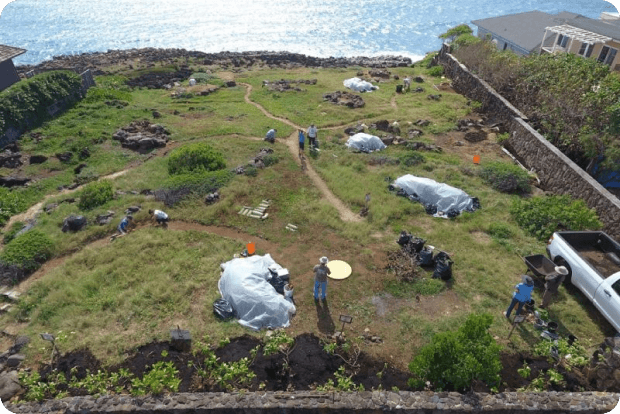
In 2007, a weed-covered plot in Honolulu was donated to the Hawaiʻi Audubon Society (HAS) to restore and protect ‘ua‘u kani. To make this land safe for shearwaters, HAS immediately began an intensive community-based restoration program on the property. Hawaiʻi Pacific University and Oikonos began studying and customizing artificial nests for this seabird population in 2009. This transformed site became the Freeman Seabird Preserve, the only protected shearwater breeding site on Oʻahu’s densely developed south shore.
Since restoration began, the number of shearwater nests has increased every year. The colony has more than quadrupled, offering a powerful example of how wildlife and people can coexist in urban spaces. The success of this colony shows that when we provide safe habitat, native species can thrive, even in the heart of a city.
Raising awareness for Hawaiʻi’s seabirds
To share the success of the Freeman Seabird Preserve, we inspire stewardship through our formal curriculum, Way of the Wedgie. Developed for middle and high school, Way of the Wedgie teaches STEM+Art skills through the eyes of ʻuaʻu kani nesting at the Preserve.
ʻUaʻu kani, like many burrow-nesting seabirds, face numerous threats: loss of native vegetation, introduced predators, and habitat degradation from development. They are also vulnerable to light pollution, collisions with utility poles, and entanglement in plastic waste and discarded fishing gear.
These challenges are shared by other endangered Hawaiian seabirds, many of which are now restricted to remote mountain breeding sites or offshore islets far from public view. In contrast, the accessible colony at the Preserve offers a rare opportunity to connect people with seabirds. As an urban ambassador, ʻuaʻu kani helps raise awareness of the broader threats facing seabirds and the simple actions we can take to protect them.
Indigenous Land Acknowledgement
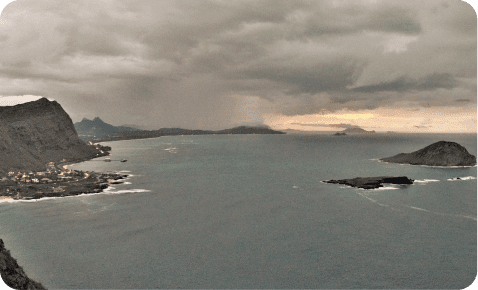
The Freeman Seabird Preserve is on the island of Oʻahu, where kānaka ʻōiwi (Native Hawaiians) reside. The land is within the ahupuaʻa (watershed land division) of Waikīkī within a wahi (place) called Kūpikipikoʻō (also known as Black Point).
Other Initiatives

Educational resources
Educational resourcesThe following free resources were created with multiple partners and there is something for all ages.Learn about unique...

Schools & Communities
Schools & Communities:Through innovation, science and art, we have promoted environmental education programs since 2002. We seek to generate...

Innovative nests
Innovative nests As climate change and human development degrade the quality and availability of breeding bird habitat, safe nesting sites for...

Hawaii Freeman Seabird Preserve
At the Freeman Seabird Preserve we provide Ua’u kani, Wedge-tailed Shearwaters, safe nesting habitat with the participation of Hawaii residents in restoration and education.
Other Species

Humboldt Penguin
Humboldt Penguin Endemic species of the Humboldt Current, an extraordinarily productive marine ecosystem.Conservation In the 19th century, hundreds...

Wedge-tailed Shearwater
Wedge-tailed Shearwater This oceanic seabird often feeds with tuna schools and serves as an important sign of ocean health in the warm waters of the...

Tufted Puffin
Tufted Puffin An iconic species of the North Pacific, the Tufted Puffin has been declining for several decades throughout much of its...

Wilson’s Phalarope
Wilson’s Phalarope A small and charming migratory shorebird that specializes on saline lake habitats, the Wilson’s phalarope is threatened with...

Cassin’s Auklet
Cassin’s Auklet Experts at diving for small krill and larval fish, these seabirds are vulnerable to changes in ocean temperature and...

Rhinoceros Auklet
Rhinoceros Auklet Long-lived ecosystem engineers and indicators of marine and island health.Natural history A close relative of puffins, the...

Masafuera Rayadito
Masafuera Rayadito It is a poorly known and critically endangered landbird unique to only one island in the worldNatural history Endemic to the...

Juan Fernández Firecrown
Juan Fernández Firecrown Endemic to Robinson Crusoe Island and on the verge of extinction.Natural history Only inhabits the native forest of...

Black-footed Albatross
Black-footed Albatross A charismatic ambassador for ocean stewardship, this species travels vast distances to forage and encounters many threats...

Pink-footed Shearwater
Pink-footed Shearwater A remarkable seabird that travels thousands of kilometers across the Pacific Ocean, returning to just three Chilean islands...