
Conservation fences
Breeding seabirds face competition and predation at increasingly disturbed island habitats. Human-introduced species such as cats, rats, coatimundis and cattle can eat the chicks, adults, and/or eggs and trample fragile seabird burrows. Conservation fences are customized structures designed to protect breeding seabirds by creating a safe barrier between nesting habitat and non-native predators and grazers. Oikonos collaborates with experts to design and install customized conservation fences around vulnerable seabird colonies and track improvements in reproductive success. With safe habitat to breed, seabirds have a higher chance of surviving and fledging their chicks – crucial for the recovery and future of their populations.
Juan Fernández Island:
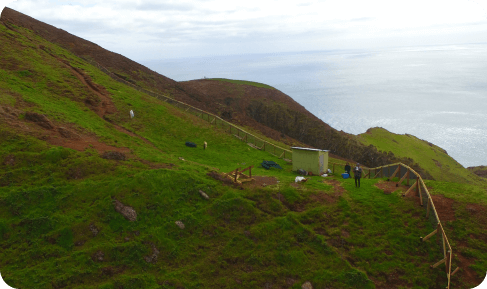
The Piedra Agujereada conservation fence in the Juan Fernández Islands protects the second largest Pink-footed Shearwater colony on Robinson Crusoe Island and is the first of its kind in South America. It surrounds the burrows of at least 1,200 breeding pairs, protecting them from predation by introduced mammals and from trampling and crushing by cows. Strong posts and electrically-charged lines keep cattle from pushing the fence over. A buried wire mesh skirt stops animals from digging underneath the fence, and a sloping shield along the top prevents cats and coati from climbing over. Oikonos worked directly with material designers and island locals to make the project affordable, and thus replicable at other sites. Completed in 2021, we are now working to track the growth and health of the shearwater colony within the fence. The area within the fence will also provide us with a wonderful opportunity to begin native plant restoration work in the heart of the colony.
Año Nuevo Island:
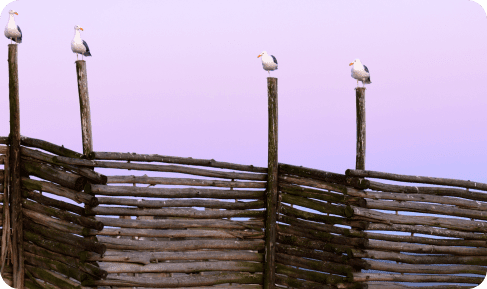
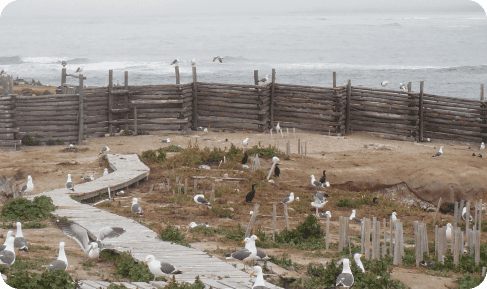
The conservation fence at Año Nuevo Island, called the Habitat Ridge, separates burrowing seabird habitat from the California sea lion rookery. It protects the dense colony of Rhinoceros and Cassin’s auklets that dig their nests in the fragile, sandy island soil within the fence from being accidentally crushed by the seals – which rely on the island sanctuary to rest and raise their pups. Constructed of local Eucalyptus (an introduced species in California), the fence is strong, sustainably built, and blends into the island landscape. It offers researchers a visual barrier to study the seals and cormorants outside the fence without disturbing them and provides shelter for nesting Western Gulls. Since its installation in 2011, the Rhinoceros Auklet colony has more than doubled, with 600 birds nesting at the island in 2022, and over 90% of breeding pairs nesting inside the fenced area.
Even strong fences need maintenance to keep them long lasting and functional for the bird colonies within. Our studies help us understand the impact of this solution and applications for other vulnerable seabird colonies.
Partners and Funders:
We work with diverse partners to create and fund these innovative fences. California: Año Nuevo State Park, Go Native, Rebar Group, Luckenbach Oil Spill Trustee Council, and Honda Marine Science Foundation. Juan Fernandez Islands, Chile: CONAF, Island Conservation, Wildlife Management International, National Fish and Wildlife Foundation and Environment and Climate Change Canada.
Related species

Cassin’s Auklet
Cassin’s Auklet Experts at diving for small krill and larval fish, these seabirds are vulnerable to changes in ocean temperature and...

Pink-footed Shearwater
Pink-footed Shearwater A remarkable seabird that travels thousands of kilometers across the Pacific Ocean, returning to just three Chilean islands...
Related Projects
Threatened Species Plans (RECOGE)
Threatened Species Plans (RECOGE)In Chile, the national action plan (RECOGE) is led by the Ministry of the Environment to contribute to the...

Habitat restoration
Habitat restorationHealthy plants and stable soil support healthy breeding birds and island ecosystems. Oikonos partners with restoration experts to...

Innovative nests
Innovative nests As climate change and human development degrade the quality and availability of breeding bird habitat, safe nesting sites for...

Wedge-tailed Shearwater
Wedge-tailed Shearwater This oceanic seabird often feeds with tuna schools and serves as an important sign of ocean health in the warm waters of the...