
Papahānaumokuākea
At the oldest coral reef in the Hawaiian Archipelago, we partner with the State of Hawaii to learn, through research and education, how plastic pollution, fisheries, and climate change are impacting wildlife.
History of the site
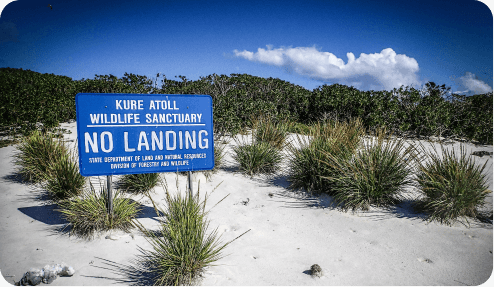
Hōlanikū, or Kure Atoll, is more than 1,500 miles northwest of Honolulu and is the northernmost atoll of the Hawaiian archipelago. Therefore, Kure Atoll is the eldest in the chain of islands and atolls that make up Papahānaumokuākea Marine National Monument, commonly known as the Northwestern Hawaiian Islands. These islands are recognized culturally as the kūpuna (ancestral) islands. Oikonos has a long relationship with the State of Hawaii and Kure Atoll Conservancy, the land managers and stewards of this refuge.

Context
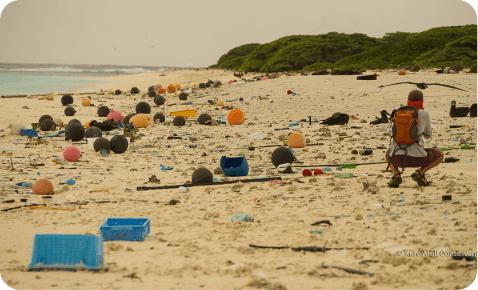
Our work at Kure Atoll focuses on international bycatch and plastic pollution. Currently, our partners on Kure Atoll are key collaborators in the Winged Ambassadors program with the goal of teaching STEM (Science, Technology, Engineering and Math) and ocean stewardship through the eyes of albatross. Even students that live far from the ocean are interested and feel empathy for the large majestic albatrosses and their lives in a remote archipelago. This program is unique in the world as we bring real “boluses” thrown up by Kure’s albatrosses into school programs to learn that our trash ends up in the ocean and even the stomachs of marine animals. The program’s impact has been a great success, reaching over 360,000 students in 47 U.S. states and 38 countries. Educators can participate in our bolus program by contributing data collected from Kure’s albatross boluses.
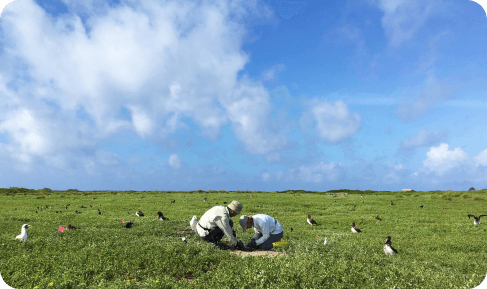
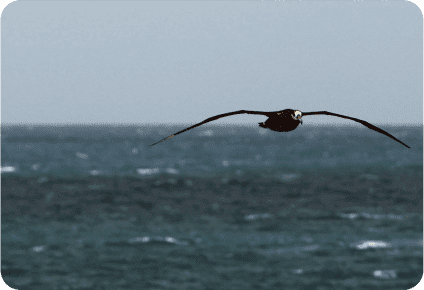
Also with our Kure Atoll partners, beginning in 2012, we led research to GPS track Black-footed Albatross parents to understand movement patterns and where they overlap with longline fisheries and marine debris. We discovered the importance of the western regions of the North Pacific for these large albatross nesting colonies near the dateline. In addition to the U.S., movement data identified that Japan and Russia have responsibility for albatross conservation. This rare tracking data is publicly available and has been incorporated into many large scale research questions by partners.
Indigenous Land Acknowledgement
We acknowledge Hawaiʻi as an indigenous space where the descendants are kānaka ʻōiwi or Native Hawaiian. Hōlanikū, meaning “bringing forth heaven,”corresponds to the location of Kure Atoll as the farthest and oldest exposed coral reef. This name is used in many different contexts to describe the homeland of gods such as Kāne and Kanaloa, Nāmakaokaha‘i, and Walinuʻu.
Other Initiatives

Student scientists – plastic in albatross diet
Student scientists - plastic in albatross dietOcean pollution continues to be a global problem for ecosystems and humankind. The Student Scientist...
Plastic in the food webs: tunas and emerging species
Plastic in the food webs: tunas and emerging speciesOikonos initiated the Biological Indicators of Ocean Plastic Pollution (BIOPs) Network to study...
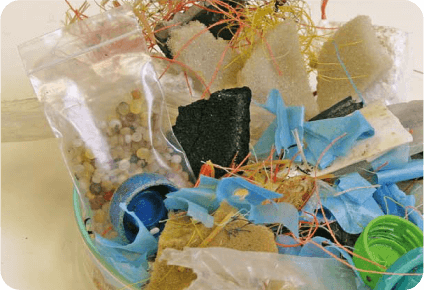
Tracking Marine Plastic Pollution: Is it increasing?
Tracking Marine Plastic Pollution: Is it increasing?The Biological Indicators of Ocean Plastic Pollution (BIOPs) program seeks to improve ocean...

Wedge-tailed Shearwater
Wedge-tailed Shearwater This oceanic seabird often feeds with tuna schools and serves as an important sign of ocean health in the warm waters of the...

Kure Atoll
En el arrecife de coral más antiguo del archipiélago de Hawái, nos asociamos con el estado de Hawái para aprender, a través de la investigación y la educación, cómo la contaminación plástica, la pesca y el cambio climático están afectando la vida silvestre.
Other Species

Humboldt Penguin
Humboldt Penguin Endemic species of the Humboldt Current, an extraordinarily productive marine ecosystem.Conservation In the 19th century, hundreds...
Wedge-tailed Shearwater
Wedge-tailed Shearwater This oceanic seabird often feeds with tuna schools and serves as an important sign of ocean health in the warm waters of the...

Tufted Puffin
Tufted Puffin An iconic species of the North Pacific, the Tufted Puffin has been declining for several decades throughout much of its...

Wilson’s Phalarope
Wilson’s Phalarope A small and charming migratory shorebird that specializes on saline lake habitats, the Wilson’s phalarope is threatened with...

Cassin’s Auklet
Cassin’s Auklet Experts at diving for small krill and larval fish, these seabirds are vulnerable to changes in ocean temperature and...

Rhinoceros Auklet
Rhinoceros Auklet Long-lived ecosystem engineers and indicators of marine and island health.Natural history A close relative of puffins, the...

Masafuera Rayadito
Masafuera Rayadito It is a poorly known and critically endangered landbird unique to only one island in the worldNatural history Endemic to the...

Juan Fernández Firecrown
Juan Fernández Firecrown Endemic to Robinson Crusoe Island and on the verge of extinction.Natural history Only inhabits the native forest of...

Black-footed Albatross
Black-footed Albatross A charismatic ambassador for ocean stewardship, this species travels vast distances to forage and encounters many threats...

Pink-footed Shearwater
Pink-footed Shearwater A remarkable seabird that travels thousands of kilometers across the Pacific Ocean, returning to just three Chilean islands...