
California: Mono Lake
At this vast and ancient lake, which is more than twice as salty as the ocean, we work to understand the ecology and threats to migratory shorebirds that rely on the unique ecosystems of saline lakes.
Saline lakes are threatened globally, and so are the birds that rely on them
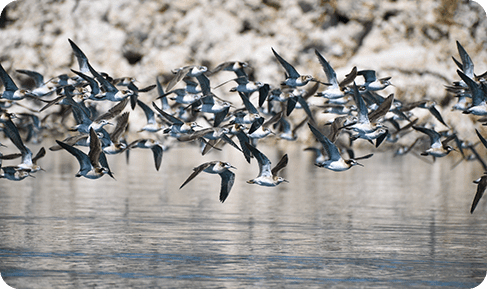
“Terminal” lakes are those that do not drain to the ocean—as water comes in and only leaves by evaporation, these lakes become extremely salty, or “saline”, creating unique and extreme ecosystems. Saline lakes are globally threatened, as the freshwater that feeds them is redirected for agricultural, urban, and industrial use at unsustainable rates. Located on the east side of the Sierra Nevada mountains and fed by snowmelt from its peaks, Mono Lake is 2.5 times saltier than the ocean and supports invertebrate prey for over a million migratory and breeding birds. Mono Lake was “saved” from excessive water diversions to Los Angeles by a legal victory in the 1990s, but faces the continuing threat of dipping below a safe level for its unique ecosystem. It supports one of the largest breeding colonies of California gulls globally, and is a critically important stopover and fueling station for migrating phalaropes and eared grebes. Our work at Mono Lake focuses on phalaropes, long-distance migrant shorebirds that rely on saline lakes from Canada to Argentina.

Protecting phalaropes and saline lakes across the hemisphere
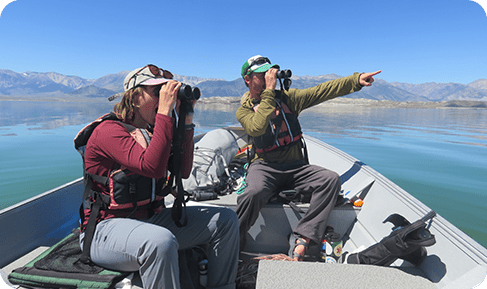
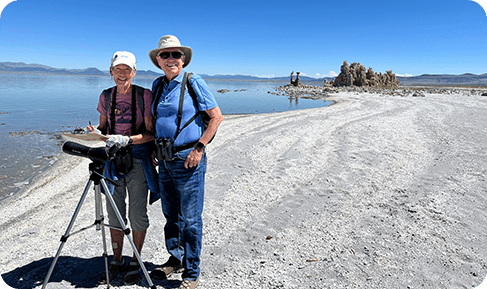
Oikonos leads hemisphere-wide efforts to coordinate phalarope and saline lake conservation and research throughout the Americas. Our core work is focused on Mono Lake, where we conduct research phalarope population trends and habitat use through surveys, and study phalarope migratory movements using nano-tags. We coordinate surveys with regional partners to create a snapshot of phalarope numbers across major migratory sites in western North America, and coordinate on tagging for movement studies with partners from Canada to Argentina. Our work draws attention to the urgent conservation needs for saline lakes across the Americas, highlighting the story of the Wilson’s phalarope, which relies on saline lakes throughout the entire hemisphere for survival. We co-led a proposal to list the Wilson’s phalarope as Threatened in the United States based on the imminent threats to Great Salt Lake and other key habitats.
In addition to phalarope research, we lead the Intermountain West Shorebird Survey for the Eastern Sierra region, and contribute to other collaborative ecosystem research at Mono Lake. We also co-founded and co-lead the International Phalarope Working Group, made up of researchers and conservationists from throughout the Americas, focused on phalarope and saline lake conservation.
Indigenous land acknowledgement
Mono Lake is located on the unceded territory of the Kootzaduka’a people, who are working to obtain Federal recognition as a sovereign Native American Tribal Nation and remain steadfast in the goal to achieve recognition and a land base for their people within their traditional homeland.
Other Initiatives

Curriculum STEM+Art
Curriculum STEM+ArtWe create free lessons aligned with common core and state standards so educators have an inspiring way to teach required STEM...

Educational resources
Educational resourcesThe following free resources were created with multiple partners and there is something for all ages.Learn about unique...
International Phalarope Working Group
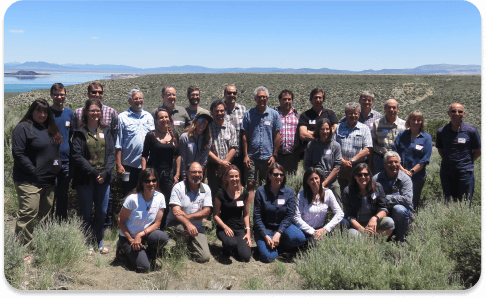
International Phalarope Working GroupPhalaropes are tiny shorebirds that make impressive migrations between North and South America and rely heavily...

Mono Lake
At California’s second largest saline lake and a crucial stopover for migratory shorebirds, Oikonos works to understand the local and global population status and threats to Wilson’s and Red-necked phalaropes.
Other Species

Humboldt Penguin
Humboldt Penguin Endemic species of the Humboldt Current, an extraordinarily productive marine ecosystem.Conservation In the 19th century, hundreds...

Wedge-tailed Shearwater
Wedge-tailed Shearwater This oceanic seabird often feeds with tuna schools and serves as an important sign of ocean health in the warm waters of the...

Tufted Puffin
Tufted Puffin An iconic species of the North Pacific, the Tufted Puffin has been declining for several decades throughout much of its...

Wilson’s Phalarope
Wilson’s Phalarope A small and charming migratory shorebird that specializes on saline lake habitats, the Wilson’s phalarope is threatened with...

Cassin’s Auklet
Cassin’s Auklet Experts at diving for small krill and larval fish, these seabirds are vulnerable to changes in ocean temperature and...

Rhinoceros Auklet
Rhinoceros Auklet Long-lived ecosystem engineers and indicators of marine and island health.Natural history A close relative of puffins, the...

Masafuera Rayadito
Masafuera Rayadito It is a poorly known and critically endangered landbird unique to only one island in the worldNatural history Endemic to the...

Juan Fernández Firecrown
Juan Fernández Firecrown Endemic to Robinson Crusoe Island and on the verge of extinction.Natural history Only inhabits the native forest of...

Black-footed Albatross
Black-footed Albatross A charismatic ambassador for ocean stewardship, this species travels vast distances to forage and encounters many threats...

Pink-footed Shearwater
Pink-footed Shearwater A remarkable seabird that travels thousands of kilometers across the Pacific Ocean, returning to just three Chilean islands...