
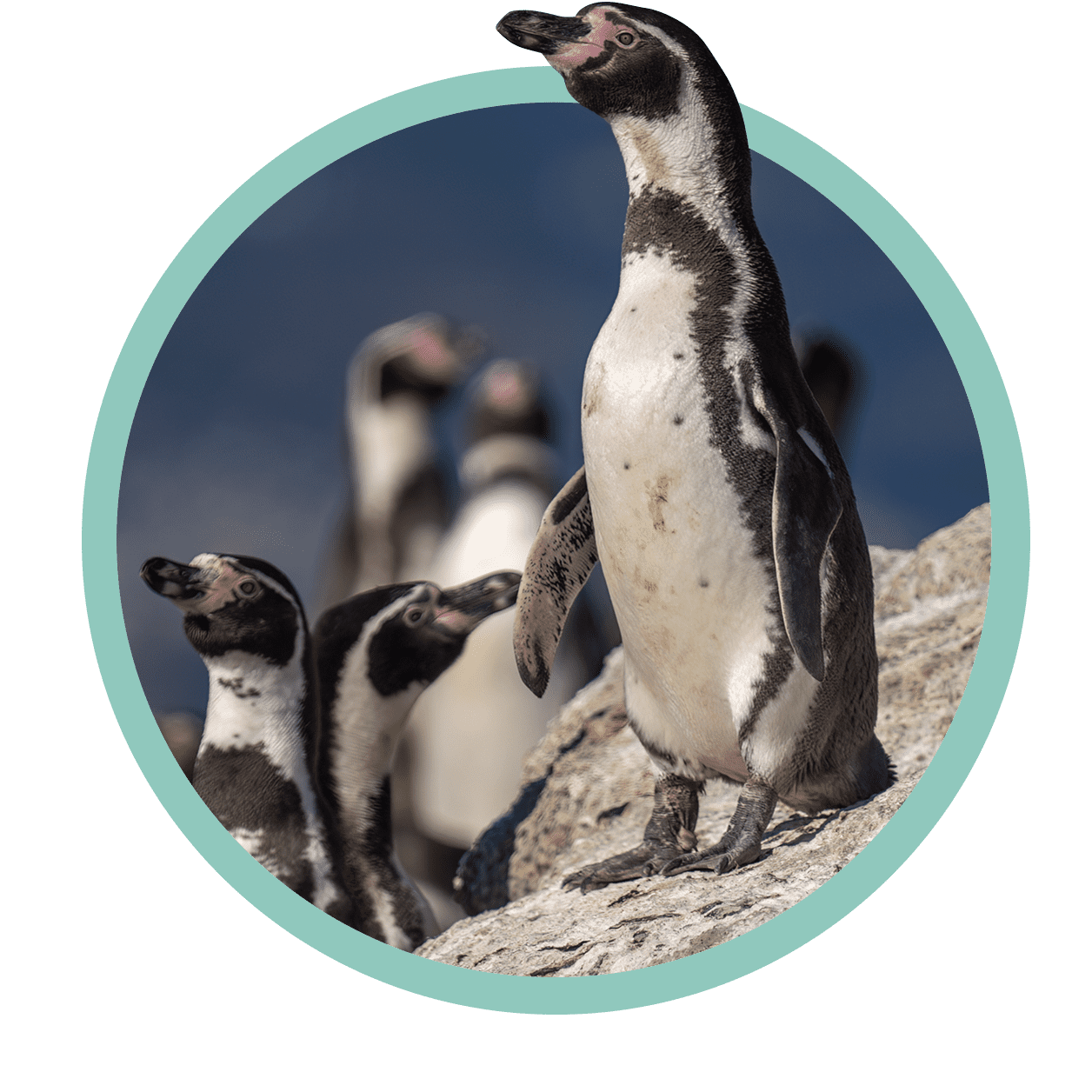
Conservation
In the 19th century, hundreds of thousands of penguins were reported in Chile and Peru. However, between 1999 and 2008, population estimates averaged around 33,384 individuals (based on counts conducted during molting season). By 2017, Dr. Alejandro Simeone and his team estimated that only about 5,000 breeding pairs remained in Chile.
Over time, the Humboldt penguin has suffered alarming population declines. Major threats to the species include incidental capture in gillnets, the effects of El Niño events, and avian influenza, all of which have significantly impacted populations in recent years.
Today, the main colonies in Chile are found on Choros Island (within the Humboldt Penguin National Reserve), as well as Tilgo, Pájaros, and Cachagua islands.
At Oikonos, we foster partnerships between scientists, government agencies, and local communities to enhance knowledge, coordinate monitoring efforts, and support the conservation of Humboldt penguins across their range in Chile and Peru. We study their interactions with fisheries to better understand the impact of bycatch. We also contribute to the development and implementation of public policies, such as the RECOGE Plan (Recovery, Conservation, and Management), which focuses on protecting the species. In addition, we help standardize binational census methods to more accurately assess the health of their populations.

About the species
The Humboldt penguin inhabits the coastline from northern Peru to southern Chile, with its main breeding colonies located in north-central Chile.
These penguins are monogamous, forming strong bonds with a single partner for breeding. Both parents share responsibilities, taking turns caring for the chicks and foraging for food. At the beginning of the breeding season, which takes place in either spring or fall, the pair returns to the same burrow or cave, depending on food availability and weather conditions.
During the breeding season, they typically forage within a range of 10 to 30 kilometers from their colony. In years marked by abnormal oceanographic events, such as El Niño, changes in water temperature and marine productivity can push them beyond their usual range and lead to temporary pauses in reproduction. Their diet varies by region: in the north, they primarily feed on species like the Peruvian silverside and anchoveta, while in the south, anchoveta, sardines, and silversides are more common.


Other Species

Wedge-tailed Shearwater
Wedge-tailed Shearwater This oceanic seabird often feeds with tuna schools and serves as an important sign of ocean health in the warm waters of the...

Tufted Puffin
Tufted Puffin An iconic species of the North Pacific, the Tufted Puffin has been declining for several decades throughout much of its...

Wilson’s Phalarope
Wilson’s Phalarope A small and charming migratory shorebird that specializes on saline lake habitats, the Wilson’s phalarope is threatened with...

Cassin’s Auklet
Cassin’s Auklet Experts at diving for small krill and larval fish, these seabirds are vulnerable to changes in ocean temperature and...

Masafuera Rayadito
Masafuera Rayadito It is a poorly known and critically endangered landbird unique to only one island in the worldNatural history Endemic to the...

Juan Fernández Firecrown
Juan Fernández Firecrown Endemic to Robinson Crusoe Island and on the verge of extinction.Natural history Only inhabits the native forest of...

Black-footed Albatross
Black-footed Albatross A charismatic ambassador for ocean stewardship, this species travels vast distances to forage and encounters many threats...